

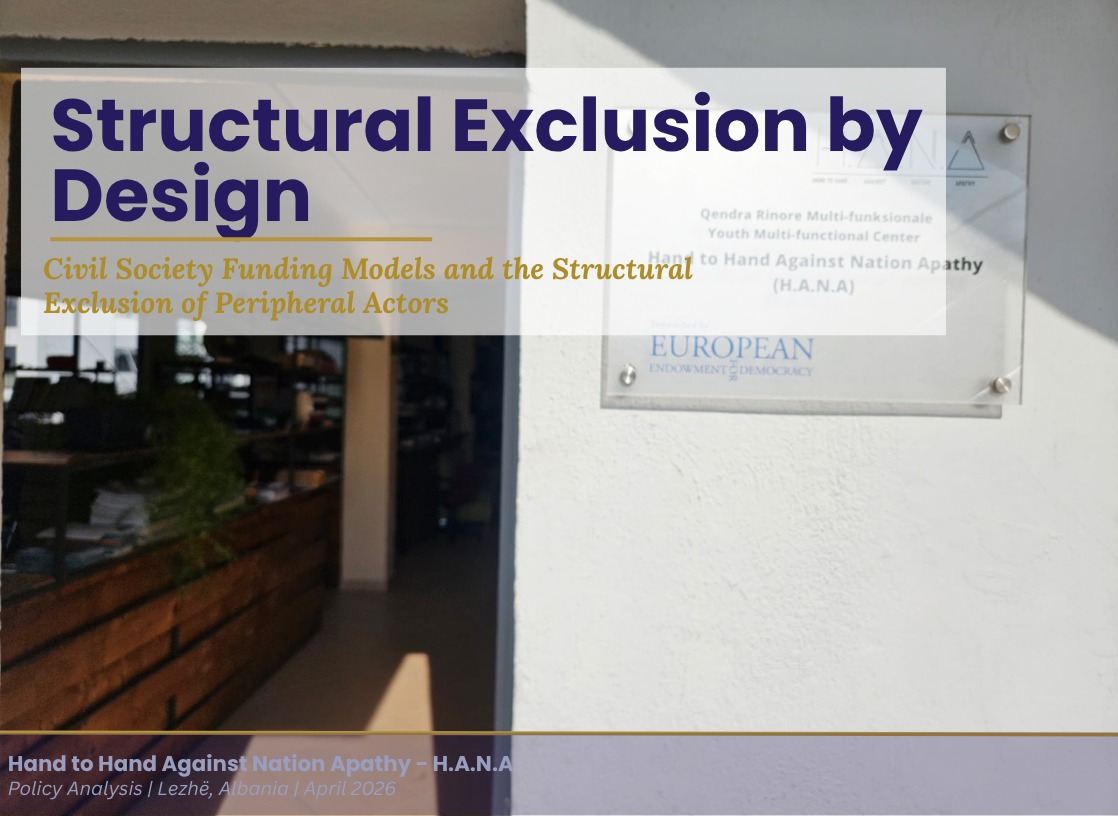
Civil Society Funding Models and the Marginalization of Peripheral Actors
Hand to Hand Against Nation Apathy – H.A.N.A | Lezhë, Albania | Policy Analysis | April 2026
I. OPENING
A common assumption in international democracy assistance is that civil society organizations operating in candidate countries benefit from an expanding ecosystem of support, one that, as EU integration deepens, progressively reaches more actors, in more places, with more meaningful resources. In countries like Albania, where EU accession is both a political commitment and a daily rhetorical reference, this assumption is particularly persistent. It is also, in significant measure, false.
The organizations that international donors most frequently cite as evidence of civil society vitality, independent, community-rooted, operating outside government networks, willing to challenge power in politically hostile local environments, are, structurally, among the least likely to receive the kind of funding that would allow them to grow. They are visible enough to be referenced, credible enough to be consulted, and chronically under-resourced enough to remain permanently dependent. This is not an accident of limited budgets or imperfect program design. It is an outcome the current funding architecture reliably and predictably produces.
This observation is not confined to the Albanian context. In a January 2026 policy paper published under the AUTHLIB research program co-funded by the European Union, Daniel Hegedüs, Former Regional Director for Central Europe at the German Marshall Fund of the United States, argues that dominant framings of civil society decline, including the widely used concept of ‘shrinking civic space,’ function as political euphemisms that ‘describe processes of change without identifiable actors’ and ‘entirely remove the responsible actor from the conceptual framework’ (Hegedüs, 2026). The present analysis proceeds from the same premise: that naming the structural mechanisms which produce civil society exclusion is a prerequisite for addressing them, and that the Albanian peripheral context makes those mechanisms unusually visible.
The current moment lends this analysis particular urgency. The collapse of US democracy assistance in the Western Balkans and Eastern Partnership countries, documented at $370.8 million in 2023 alone (Hegedüs, 2026; Bohrn, 2025), has created a funding vacuum in exactly the spaces where independent civil society was most active. Albania receives bilateral ODA, but as an upper-middle income candidate country it receives significantly less per capita than lower-income recipients, and the democracy and governance portion of that ODA was heavily dependent on USAID programming which has now collapsed. The EU’s own funding instruments for candidate countries, primarily IPA, are structured differently from development ODA and are channeled primarily through government structures rather than civil society directly. Switzerland’s Agency for Development and Cooperation, which committed 105 million Swiss francs to Albania’s democratic governance and civil society programming for 2022-2025 and had begun a consultative process across municipalities to design a new core support mechanism for civil society, announced in January 2025 that its bilateral development programme in Albania would be phased out by 2028 following parliamentary budget cuts. A process that created genuine expectations among civil society organizations across the country, including through direct outreach meetings at municipal level, was cancelled before the mechanism it was designing ever opened. This is the full picture of the external funding environment: not one collapse, but several, arriving simultaneously.
The European Commission’s 2025 Albania Progress Report confirms what organizations operating in this space experience directly: ‘CSOs operate in a partly enabling environment, but have faced an increase in negative narratives particularly during the reporting period, including smear campaigns targeting their impartiality and funding. Tax incentives remain marginal and public funding is insufficient. The lack of specific measures to protect them from intimidation and legal threats contributed to this situation’ (European Commission, 2025b). This article attempts to name those conditions from the inside, and to document the mechanisms that produce them with greater specificity than aggregate reporting allows.
This is not aggression. It is the minimum precision that the evidence requires.
II. THE CORE ARGUMENT
Civil society outcomes in Albania and comparable peripheral contexts are shaped less by the capacity of individual organizations than by the structural conditions under which funding reaches, or fails to reach, them. The question is not whether civil society can do more. It is whether the systems through which resources flow are designed to allow it.
Two claims establish the ground. First, funding is not neutral: the conditions attached to grant instruments embed assumptions about risk, organizational maturity, and accountability that systematically advantage actors who have already received funding over those who have not. Second, structure shapes behavior: organizations adapt to the environment they inhabit, and when that environment rewards compliance and penalizes independence, the sector reflects it.
A third claim follows, and its weight becomes clear once the mechanism is visible: in contexts where the political landscape actively discourages genuine civic autonomy, where local governments treat independent civic action as a threat rather than a function, the structural design of funding programs is not a technical question. It is a democratic one.
The 2025 EU Strategy for Civil Society acknowledges the importance of an ‘open, safe and enabling civic space’ (European Commission, November 2025), yet, as Hegedüs notes, the strategy ‘remains silent on what is arguably the most serious threat to civic space’: the structural conditions that prevent the most genuinely independent actors from accessing meaningful support (Hegedüs, 2026). This article attempts to name those conditions from the inside.
III. THE STRUCTURAL MODEL
Most international civil society programming in Albania operates through what can be described as a Three-Tier Funding Structure, or, more broadly, an intermediary-based funding architecture. This model is the dominant design logic in multi-country democracy assistance programs across the Western Balkans and beyond. Naming it as a model, rather than treating it as a neutral default, is the first step toward evaluating whether it is fit for purpose.
In candidate countries, where civil society is expected to play a central role in monitoring governance and supporting rule of law reforms, the long-term marginalization of independent local actors presents a contradiction within the accession framework itself. The democratic standards Albania is asked to meet depend on exactly the kind of organizational ecosystem that the current funding model structurally prevents from developing.
Tier 1: Donors
Bilateral agencies, EU delegations, and international institutions hold agenda-setting authority and ultimate accountability to their own governance bodies. Their primary concern is portfolio-level risk management: ensuring that resources are deployed in ways that are auditable, demonstrable, and defensible to constituencies far from the field.
Tier 2: Intermediaries
International NGOs or regional implementing partners occupy the middle layer. They absorb programmatic complexity, manage the compliance interface between donor requirements and local realities, and serve as trusted brokers. Their optimization target is contract performance: delivering agreed outputs on time, within budget, and within the relational terms that will secure the next award.
Tier 3: Local CSOs
Organizations operating outside the capital, especially those without government alignment, form the base. They execute activities, provide community legitimacy, and absorb local political risk. Their optimization target, whether they articulate it as such or not, is survival: enough income to maintain staff, enough continuity to retain identity, enough visibility to appear in the next call.
Each tier optimizes rationally for its own position. Donors gain control and lose proximity to context. Intermediaries gain scale and lose programmatic ownership. Local organizations gain access to resources and lose strategic autonomy. The aggregate result is a system that is efficient at producing outputs that satisfy reporting requirements, while failing to produce the institutional conditions those outputs are meant to sustain. The result is a structurally managed civil society sector: visible, active, and externally validated, but constrained from developing independent institutional power.
IV. THE MECHANISM OF DISTORTION
Six mechanisms explain how this architecture produces the outcomes it does.
A. The Track Record Trap
Direct access to meaningful funding requires a documented history of managing equivalent resources. That history can only be built by managing equivalent resources. Organizations in the periphery, who have never been granted direct access to major funding precisely because they lack the track record, find themselves locked in a structurally circular position: ineligible for the funding that would make them eligible. The gate is real, the logic internally coherent, and the consequence permanent: organizations cannot demonstrate what they have never been given the opportunity to demonstrate.
This trap operates not only at the level of international grant architecture but at the level of domestic public funding as well. AMSHC, Albania’s primary state funding body for civil society, operates calls in which eligibility and scoring are formally open but practically oriented toward organizations with established administrative capacity and alignment with government strategic priorities. Of 160 applications to the 2025 Call 18, requesting a combined 272 million lek, 75 projects were approved, with 32 winners based in Tirana and 19 in Vlorë. Organizations based in secondary municipalities received marginal representation. The track record trap operates at every level simultaneously.
B. Incentive Distortion and the Sustainability Paradox
Short project cycles, twelve to thirty-six months, make long-term institutional investment economically irrational. Organizations that absorb political risk, confronting local governments, filing transparency requests, challenging institutional actors, do so at personal and organizational cost that no grant cycle covers. The result is an organizational culture of perpetual reaction: responsive to calls, deferential to intermediaries, and structurally prevented from building the depth that real civic power requires.
A less examined dimension of this distortion is what happens to organizations that do manage to grow within the current architecture. Growth requires maintaining grant relationships whose calls favor generalistic, non-confrontational programming over civic activism and institutional accountability work. Organizations that internalize this pressure, moderating their positions, avoiding politically costly campaigns, reframing watchdog work as non-formal education, find their funding more stable. Organizations that do not moderate face the cycle described in this section. The ceiling is not only structural. It is also behavioral: organizations learn to stay below it. The sustainability of the sector is purchased at the cost of its independence.
C. The GONGO Landscape and the Active Competitor
In environments heavily populated by government-organized non-governmental organizations, entities that perform the appearance of civic independence while maintaining structural alignment with political power, genuinely independent organizations face compounded disadvantage. They lack the institutional relationships that ease access to local authorities. They lack the political protection that comes from informal alignment. They operate in communities where independence is treated, by those in power, as a provocation.
What the standard analysis of GONGO landscapes tends to understate is the active competitive dimension. GONGOs do not merely occupy civic space passively. They compete for the same funding calls, apply to the same municipal partnership programs, and in some cases actively undermine independent organizations in their relationships with local authorities and donors. In Lezhë and comparable municipalities, organizations with government alignment access local authority cooperation that independent organizations are functionally denied. This is not a level playing field on which formal neutrality of funding criteria might produce fair outcomes.
D. Risk Displacement and the Political Cost of Independence
The three-tier architecture is, at its core, a risk management system. Fiduciary risk is managed at Tier 2. Reputational risk is managed through compliance mechanisms. Political risk, the risk of operating in communities where civic action generates institutional retaliation, is transferred entirely to Tier 3, absorbed by local organizations without the resources, legal protection, or institutional backing that would make it sustainable.
In September 2025, the Mayor of Lezhë addressed the Municipal Council on recommendations submitted by H.A.N.A following a months-long civic campaign involving 112 student surveys, analysis of over 4,400 school social media posts, formal Right to Information requests, a community petition with 101 signatures, and a public protest installation. During the livestreamed session, the Mayor stated: ‘Someone might go and write some emails to donors, but I will also turn to those donors. I will not allow anyone, no NGO, to disinform donors. I am the institution. I send them the material and say: come and verify. And then the funds of these organizations go to zero.’ The live recording was subsequently removed from the Municipal Council’s Facebook page. H.A.N.A has retained a downloaded copy. H.A.N.A filed a formal complaint with the Commissioner for the Right to Information and Personal Data Protection. The Commissioner issued an official decision in H.A.N.A’s favor, affirming the organization’s right to participation and finding that the municipal consultation process had not respected the legal framework. The political risk remained entirely with the organization that had borne it.
E. The Intermediary as Gatekeeper
Organizations positioned outside established donor networks are not only excluded from direct funding. They are frequently approached as potential subgrantees through calls administered by the very intermediaries that compete with them for the same resource pool. The subgrant structure is presented as an access mechanism, but in practice it operates as a consolidation mechanism: the intermediary retains coordination overhead, sets programmatic parameters, and reports impact upward under its institutional brand. The local organization delivers the work and remains institutionally unchanged. Applications to larger calls as co-applicants are routinely redirected toward subgrant positions. This pattern reflects the intermediary’s rational interest in maintaining its administrative role and its donor relationship, neither of which is served by cultivating genuinely capable, autonomous local partners. A related but distinct mechanism operates through what might be called pre-selected architecture: calls that are formally published but structurally designed for recipients who have already been identified. Several major bilateral donors operating in Albania, including SIDA, which channels the majority of its civil society support through Swedish implementing organizations, and GIZ, which operates primarily through framework contracts with large international firms, do not in practice make direct grants available to Albanian civil society organizations at all. Their calls are open in form and closed in function. IFES, as documented elsewhere in this article, awards primary grants to established national intermediaries and opens subgrant windows to local organizations only at the second tier. The National Endowment for Democracy operates through relationship-based engagement processes in which prior visibility within democracy-support networks, personal referrals from existing partners, and sustained contact with regional program officers are prerequisites that function as informal eligibility criteria. For organizations based in peripheral municipalities without pre-existing relationships in these networks, the call was never open. The exclusion is structural and invisible, which makes it more durable than any formal eligibility criterion, because it cannot be appealed, documented, or challenged. The few genuinely competitive and unrestricted funding instruments available, including the European Endowment for Democracy, the CERV programme under specific conditions, and a small number of bilateral embassy calls, are correspondingly oversubscribed, producing competition ratios that replicate the track record trap described earlier. Scarcity at the open end of the funding architecture is not incidental. It is a predictable consequence of how closed the rest of it is.
F. Public Prejudice and the Community Trust Deficit
Civil society organizations in Albania, particularly those engaged in civic education, accountability monitoring, and institutional advocacy rather than material humanitarian assistance, operate in a public environment where the sector is frequently characterized as composed of money-grabbers, foreign-funded actors with no genuine community connection, or instruments of external political agendas. This characterization is actively promoted by political actors who benefit from weak civic oversight.
The consequence for independent organizations is that community trust must be built from scratch, against an actively hostile framing, without the institutional legitimacy that government alignment confers and without the immediate social recognition that comes from distributing material goods. This effort is real, sustained, and unfunded. No grant line covers the years of presence, relationship-building, and reputational investment required to maintain credibility in a community that has been told, repeatedly, that the organization’s motives are suspect.
V. THE PARADOX OF ENCOURAGEMENT
There is a specific dynamic worth naming, because it is both common and underexamined. Donors frequently maintain warm, supportive relationships with civil society organizations they consider too small or insufficiently experienced to fund directly. They acknowledge the quality of the work. They encourage the organization to continue. They point to its independence as evidence that civil society is diverse and vibrant. They use it as a reference point in program narratives. And they do not fund it at the scale it needs to survive.
This produces a form of institutional dissonance that organizations in this position experience acutely. They are visible enough to matter in the donor’s narrative, but not positioned within the funding architecture to receive the investment that would allow them to matter at scale. More precisely, the organization’s visibility serves the narrative of a plural and functioning civil society, while its exclusion from meaningful funding ensures that this visibility does not translate into independent institutional power.
For an organization operating under conditions of local political hostility, where sustained civic activity is costly not only financially but personally, where the community of institutional support that capital-city organizations take for granted simply does not exist, this dissonance is not merely frustrating. It is, over time, existentially threatening. Carothers and Brechenmacher (2014) documented the broader pattern of structural penalization facing organizations that challenge power, a logic this analysis extends to the internal architecture of funding systems themselves. More than a decade later, the structural logic they described has not changed.
VI. THE CIRCULAR TRAP
This is where the dynamics described above converge into something more than a set of structural inefficiencies. They converge into a self-reinforcing cycle. An organization without a direct-grant track record applies for funding. It is assessed against eligibility criteria that presuppose that track record. It does not pass the capacity threshold, not because its work is insufficient, but because the system has no mechanism for distinguishing between organizations that are institutionally immature and organizations that are institutionally strong but structurally excluded. It is redirected to a subgranting mechanism managed by an intermediary. It receives funding at a controlled scale, under external programmatic logic, through a layer of oversight that limits operational autonomy. It delivers. The intermediary absorbs a portion of the resource. The organization’s institutional profile remains unchanged. The next call opens. The cycle repeats.
This loop persists not because anyone intends it. It persists because it is rational at every tier. Donors are managing real risk with real accountability. Intermediaries are performing real functions under real contractual pressure. The local organization is making the only available choice: take what is offered, or receive nothing. Each actor is behaving correctly within the system’s logic. The system’s logic is the problem.
What the loop produces, over years, is a civil society sector in which the most independent, most community-rooted, most politically exposed organizations remain permanently small, not because of what they lack, but because of what the system is not designed to give them. The ceiling is architectural. And because it is architectural, it is invisible to evaluations that measure organizational capacity without measuring the conditions under which that capacity was, or was not, allowed to develop. The long-term effect is not simply inefficiency. It is the systematic underdevelopment of the very actors upon whom democratic accountability depends.
VII. THE DOMESTIC DIMENSION: PUBLIC FUNDING AS A CLOSED GATE
The analysis above focuses on international funding architecture. But independent civil society organizations in Albania face a parallel and equally consequential exclusion from domestic public funding channels. These are not separate problems. They are reinforcing ones. An organization excluded from AMSHC cannot build the domestic institutional track record that might compensate for exclusion from international direct grants. An organization excluded from international direct funding cannot demonstrate the financial management history that domestic evaluators increasingly expect. The two gates close on each other: the international architecture assumes that credible local organizations will have domestic institutional standing, while the domestic system assumes that credible organizations will have international donor validation. Organizations that have neither, not because they lack capacity but because both systems structurally exclude the same profiles, find themselves locked out at every level simultaneously. This dimension is rarely addressed in policy literature focused on the international donor ecosystem, and it is rarely articulated by organizations that remain dependent on government goodwill for local operating conditions. It deserves direct naming.
Albania’s primary state funding mechanism for civil society, AMSHC, was established by law in 2009. Its legal framework includes formal competition procedures, conflict-of-interest rules, and calls for proposals. In practice, documented structural problems have persisted for over a decade. In 2014, the Balkan Investigative Reporting Network reported that grants worth 19.9 million lek had been awarded between 2010 and 2013 to organizations linked to AMSHC board members or their relatives. Civil society figures at the time described the arrangement as an ‘open conflict of interest’ and stated that the agency was ‘controlled by politicians’ (BIRN, 2014). In 2017, Partners Albania documented that AMSHC had distributed institutional support grants to twenty CSOs without publishing a call for proposals or a beneficiary list (Partners Albania, 2017). The Institute for Democracy and Mediation had argued that the agency’s design was fundamentally flawed: its Supervisory Board simultaneously supervises the agency and makes final grant decisions, a concentration of discretion incompatible with genuine transparency (IDM, 2014).
The 2024 grant-financing regulation introduced some procedural improvements, but the core structural problems remain. Priority areas are framed around government strategic objectives rather than civil society needs. Rejection reasons are provided only upon written request, not automatically published. Call 19, launched in 2026, explicitly frames its priorities around the government’s 2025-2029 strategic agenda. Of 160 applications in the 2025 Call 18, 75 projects were funded, with 32 winners in Tirana. Beyond AMSHC, other public channels that might theoretically support independent civic work, including national youth agency mechanisms operating under the youth law framework, are documented by Albanian civil society actors as effectively inaccessible to organizations outside trust circles defined by political alignment and institutional familiarity.
The European Commission’s 2024 Albania report stated that public funding, while respecting a legal minimum, ‘is not enough to ensure the financial viability of CSOs.’ Survey data confirm the picture: only 11 percent of Albanian NGO income comes from public funding, while 67 percent of organizations identify foreign governments as their primary income source (Partners Albania, 2024). Independent civil society in Albania is thus doubly excluded: from the international donor architecture by the mechanisms described above, and from domestic public funding by a system that remains structurally vulnerable to political preference. Both gates are closed. Organizations navigate in the space between them.
VIII. THE GEOGRAPHY OF EXCLUSION
The structural disadvantages described above are compounded by geography in ways poorly captured by aggregate national statistics. The AMSHC data cited earlier confirms the domestic pattern: 43 percent of funded projects in the 2025 Call 18 went to Tirana-based organizations alone. No comparable disaggregated data exists for international donor funding in Albania, and this absence is itself revealing: the geographic distribution of international civil society resources is not systematically tracked, reported, or evaluated by the donors distributing them. Being based in Lezhë rather than Tirana does not mean only that an organization is physically distant from decision-making centers. It means being absent from the informal networks through which opportunity circulates in the Albanian civil society ecosystem.
Information about upcoming funding calls, changes in donor priorities, new partnership opportunities, and informal signals about institutional preferences travels primarily through personal relationships maintained in the capital. Organizations with Tirana offices or regular access to the social and professional environment of Tirana’s civil society sector learn about these developments earlier, more completely, and with the contextual understanding that allows a competitive application to be prepared. Organizations in Lezhë, Shkodër, Pukë, or Peshkopi learn about the same calls when they are publicly announced, often with less time to prepare and without the contextual relationships that give meaning to the formal requirements.
A journey from Lezhë to a donor meeting in Tirana represents between 1.5 to 2 hours of travel each way. A Tirana-based organization attends the same meeting in fifteen minutes. Over a year, the accumulated cost in staff time, travel expense, and organizational energy of maintaining presence in the capital-city networks where meaningful access is negotiated is a structural tax that the current funding architecture does not recognize and no grant budget adequately covers.
The geography of legitimacy extends beyond logistics. Donor representatives based in Tirana, intermediary organizations headquartered in Tirana, and national-level civil society networks concentrated in Tirana construct their understanding of credible, capable, and trustworthy civil society from the organizations they encounter regularly. An organization that is not physically present in those networks does not benefit from the informal credibility that comes from sustained personal contact. Its track record must be demonstrated entirely through documentation rather than relationship. In a sector where relationship is itself a form of institutional capital, this is not a minor disadvantage.
IX. THE ADMINISTRATIVE COST OF EXISTENCE
Below the three tiers of the international funding architecture, and below the domestic public funding system, lies a layer of operational reality that policy analysis rarely documents: the administrative and financial environment within which local organizations must simply function as legal entities. In Albania, for organizations operating outside major urban centers, this environment is itself a source of structural burden that compounds every other disadvantage already described.
Banking institutions in Lezhë and comparable municipalities demonstrate limited familiarity with the legal and financial frameworks governing non-profit organizations. Opening an organizational account, sometimes even an additional dedicated account, a requirement of most international grant agreements, can take up to six months from application to activation. Compliance documentation required by donors, including certificates that must bear the bank’s seal and signature, generates repeated institutional confusion at branch level, with staff refusing to provide documents they incorrectly believe they are not authorized to issue. Authorization for finance staff to conduct account transactions requires updated court documentation from Tirana from certain banks (ex. Intesa San Paolo Bank), a full-day administrative undertaking, every time the authorization must be renewed or modified. These are not isolated incidents. They are documented operational experiences that consume weeks of organizational capacity per grant cycle.
Tax authorities apply to non-profit organizations the same monthly payment deadlines and the same immediate enforcement mechanisms as they apply to commercial enterprises. For businesses, the standard leniency period before account seizure is three months in practice. For non-profit organizations, which operate on grant disbursement timelines that rarely align with monthly tax cycles and which may experience multi-month liquidity gaps between reporting and tranche receipt, no comparable leniency framework exists. An organization that has submitted a financial report and is awaiting the next disbursement tranche may find its bank account seized before the tranche arrives, making it impossible to pay the staff whose salaries are covered by the incoming funds.
The liquidity gaps described above are not merely operational disruptions. In practice, they are bridged through personal financial contributions by organizational leaders. Executive directors of peripheral civil society organizations routinely advance funds from personal savings, defer their own compensation, and assume personal financial risk in order to maintain continuity between grant disbursements. This practice is neither formalized nor measured. It does not appear in organizational budgets, donor reporting frameworks, or sustainability assessments. Yet it functions as an implicit subsidy that allows the system to operate. The current funding architecture does not only transfer administrative and political risk downward. It also transfers financial burden to individuals whose personal resources compensate for structural design gaps.
The cumulative effect of these administrative barriers is significant and invisible. They consume organizational capacity. They create financial risk entirely disproportionate to organizational size. They generate compliance costs that small organizations with limited administrative staff cannot absorb without affecting program quality. And they appear nowhere in budget lines, output counts, or narrative indicators. The managed fragility that donors observe in peripheral civil society organizations is not explained entirely by insufficient grant income. It is produced in part by an administrative and financial environment that was not designed for non-profit operation and has not been adapted to serve it.
X. WHY DONORS DON’T SEE IT – AND WHY THAT IS A CHOICE
The structural critique above is not a personal indictment of individual program officers. Donors do not design exclusionary systems because they are indifferent to local civil society. They design systems under pressures that are real, legitimate, and largely invisible to the organizations at the base of the architecture.
Accountability pressure is the primary driver. Donors operate in political environments that demand demonstrable results, outputs that can be counted, reported, and defended to constituencies who require reassurance that the investment was sound. Intermediaries, with their established systems and documented track records, offer that assurance in ways that small local organizations cannot. This pressure has intensified since 2024, as the European Parliament’s post-election political configuration has subjected EU civil society funding to unprecedented institutional scrutiny (Hegedüs, 2026).
Distance from field is the secondary factor. The decision-makers who design funding architectures are rarely in contact with the granular reality of civic work in secondary municipalities. They receive reports. They see outcome indicators. They do not see the staff member who stayed beyond compensated hours to file a transparency request, or the organization whose bank account was seized while awaiting a grant tranche, or the two young team members who sat in a municipal council chamber and heard a mayor threaten to contact their donors.
The system does not persist despite donor design choices. It persists because of them. When a program officer channels resources through an established capital-city intermediary rather than a peripheral organization with a documented civic track record, they are making a choice. That choice is individually rational, institutionally defensible, and collectively destructive. Acknowledging its rationality does not dissolve its consequences. The organizations that remain permanently small are not casualties of an impersonal system. They are the predictable outcome of decisions that are made, repeatedly, by identifiable actors operating within identifiable incentive structures. Naming this is the minimum precision that the evidence requires. It was stated at the opening of this article, and the documentation assembled here is its proof.
What gets measured gets funded. What cannot be measured within standard reporting frameworks, political courage, local legitimacy, the cost of sustained independence, does not. The blind spot is structural. But the choice to leave it unaddressed is institutional.
XI. WHAT MUST CHANGE: THREE DEMANDS
Adjusting the current model does not require dismantling it. It requires targeted structural shifts in how a defined category of organizations, those with demonstrated civic value but limited institutional track records, can access resources. The policy directions below are not novel: they align with recommendations emerging from European-level policy research. What distinguishes them here is precision. Broad aspirations have not produced change. These are measurable commitments that can be agreed to or refused.
On the intermediary architecture
Demand 1: No international democracy assistance program operating in Albania should channel more than 60 percent of its civil society budget through intermediary subgrant mechanisms without publicly documenting why direct partnership with the intended implementing organizations is not feasible. Current practice in Albania regularly exceeds this threshold: major bilateral programs administered through SIDA, GIZ, and IFES channel effectively 100 percent of civil society resources through intermediary structures, leaving zero direct grant access for local organizations. A 60 percent cap would preserve the intermediary function where genuinely needed while requiring that at least 40 percent of resources flow to organizations that deliver the work. The burden of justification should fall on the choice to use an intermediary, not on the peripheral organization’s failure to qualify without one.
On geographic equity
Demand 2: Grant calls explicitly targeting civil society in candidate countries should require that a minimum of 30 percent of awards go to organizations based outside capital cities, evaluated on separate tracks that do not require prior direct-grant history as an eligibility condition. In Albania, approximately 60 percent of the population lives outside Tirana, yet capital-based organizations capture a disproportionate share of civil society funding: of 75 projects funded under AMSHC’s 2025 Call 18, 32 winners were Tirana-based. A 30 percent floor for non-capital organizations reflects a conservative correction, well below the population share these communities represent. This is not a diversity measure. It is a geographic correction to a structurally skewed baseline.
On the EED mandate extension
Demand 3: The European Endowment for Democracy’s proposed mandate extension to candidate countries should include a dedicated window of no less than two million euros annually for direct grants to peripheral civil society organizations with annual budgets under 150,000 euros, administered without intermediary overhead. Two million euros represents approximately 100 direct grants at the €20,000 level, enough to reach a meaningful number of organizations across the Western Balkans region while remaining a modest fraction of the EED’s total budget. The €150,000 annual budget threshold targets organizations large enough to demonstrate institutional viability but small enough to be systematically excluded from direct EU funding, which typically requires prior management of grants in the €300,000–800,000 range. Without a clearly defined and ring-fenced mechanism to reach these organizations directly, extending its mandate will reproduce the architecture it is meant to replace.
Immediate entry point: The EU Delegation in Tirana should establish, within 12 months, a dedicated direct grant window of no less than €300,000 annually for civil society organizations based outside Tirana, specifically targeting organizations with annual budgets under €150,000. This window should be administered without intermediary overhead and evaluated through criteria that do not require prior direct management of equivalent EU grant volumes, but instead assess operational capacity through demonstrated project implementation, local institutional engagement, and verifiable outputs. Risk management can be maintained through staged disbursement, enhanced reporting frequency, and targeted compliance support, rather than exclusion at eligibility stage.
This does not require redesigning the architecture. It requires one decision by one institution that already has the mandate, the budget, and the field presence to act. Its existence or absence will be a test of whether the commitments in this section are aspirational or operational.
Beyond these three demands, the domestic framework requires structural reform that is equally specific. AMSHC’s Supervisory Board must be separated from its grant-making function. Rejection reasons must be published automatically, not on written request. Priority-setting must be co-designed with civil society rather than aligned to government strategic objectives. Anti-SLAPP and anti-retaliation protections, currently absent from the Albanian framework, must be enacted. The European Commission has noted all of these gaps. Their persistent non-implementation is itself evidence of the structural problem this article describes.
Multi-year institutional support, distinct from project funding, remains necessary but insufficient unless accompanied by the structural reforms above. An organization that receives multi-year funding but continues to navigate a hostile banking environment, a captured domestic funding system, a two-hour travel tax on every donor meeting, and the threat of a mayor contacting its donors has gained time but not structural security. The reforms must work together.
XII. CLOSING
Hand to Hand Against Nation Apathy – H.A.N.A was founded in 2018 in Lezhë. We are the only civil society organization in the city that operates outside government-aligned networks. We built the first youth center the municipality had seen. We trained young people to read public budgets, challenge institutional opacity, and understand what democratic participation requires of them. We absorbed political pressure without institutional safety nets. We continued.
We write this not as a complaint, and not as an appeal. We write it because the dynamics described here are structurally real, they are consequential for democratic development in Albania, and they are rarely articulated by the actors who experience them most directly, in part because articulation carries its own risks for organizations that remain dependent on the systems they are describing.
Local civil society organizations are not implementation platforms. Where we function well, we are the architecture of democratic accountability at the local level, the actors who remain present after the program closes, who carry the work forward without the next grant, who hold the institutional memory of what civic engagement in our communities has required and cost.
The system that currently shapes our existence was not designed to prevent that. It was designed to manage risk and ensure accountability. We understand that. The question we are asking, directly and from the inside, is whether that design, as it currently stands, is adequate for the democratic development it is meant to support. We believe it is not.
We close with a documented fact rather than a rhetorical question. In September 2025, the mayor of Lezhë told a public municipal council meeting, on a recorded livestream subsequently removed from public access, that when non-governmental organizations write to their donors, he will write to those donors too. That he has the material to show them. That the funds of such organizations go to zero. Two young team members of this organization were present in that chamber. They had spent the preceding year conducting student surveys, analyzing thousands of public records, filing formal requests, organizing community events, and submitting detailed recommendations through every legal channel available to them.
If you are reading this as a donor, a program officer, or a policy designer: the mayor of Lezhë understood the architecture better than most reform proposals acknowledge. He knew the funds of an independent organization could be made to go to zero. He knew this because the architecture made it possible, because independent civil society in peripheral Albania has no institutional backstop, no anti-retaliation mechanism, no funding floor that a hostile local official cannot threaten. The question for the reader of this article is not whether you share his intentions. The question is whether, by the design choices you make or do not make, you share his architecture.
REFERENCES
Balkan Investigative Reporting Network (BIRN) and Open Data Albania. 2014. Grants to Board-Linked Organizations: AMSHC Investigation. Tirana.
Bohrn, Brandon. 2025. After USAID: Europe’s Moment to Lead. Bertelsmann Stiftung. Available at:
Carothers, Thomas and Saskia Brechenmacher. 2014. Closing Space: Democracy and Human Rights Support Under Fire. Carnegie Endowment for International Peace.
European Commission. 2024. Albania 2024 Report. Commission Staff Working Document. Brussels.
European Commission. November 2025. EU Strategy for Civil Society. Brussels.
European Commission. 2025b. Albania 2025 Progress Report. Commission Staff Working Document. Brussels.
European Parliament. 2022. Report on the Shrinking Space for Civil Society in Europe. 2021/2103(INI). Strasbourg.
Hegedüs, Daniel. 2026. ‘How to Better Protect and Support Civil Society in the EU? Illiberal Challenges to Civil Society, the Freedom of Association, and Civic Activism in the European Union.’ AUTHLIB Policy Papers, Series 2026:1. DOI: https://doi.org/10.60644/21nr-wc46
Institute for Democracy and Mediation (IDM). 2014. Policy Brief on AMSHC Institutional Design. Tirana.
Partners Albania for Change and Development. 2017. Monitoring Report on Civil Society Funding in Albania. Tirana.
Partners Albania for Change and Development. 2024. Civil Society Sustainability Assessment. Tirana.
Hand to Hand Against Nation Apathy – H.A.N.A | Independent civil society organization | Lezhë, Albania | Founded 2018
This article reflects independent policy analysis and does not represent the position of any funding institution or implementing organization. It may be freely cited with attribution.


